Contents
What Does It Really Mean for AI to Learn?
We hear that AI has "learned" something all the time.
The phrase appears everywhere, from news articles to advertisements, and we rarely stop to question what it actually means.
Does AI learn in the same way people do?
How a Child Learns What a Cat Is
Say you’re teaching a child what a cat is. At first, the child might call any animal that looks a bit like a cat a cat. An adult points out the differences, and as the child encounters more animals, they gradually get better at telling them apart. At some point, the child can recognize a cat they’ve never seen before.
That’s the scene that comes to mind when we hear the word “learning.”
From the outside, the way AI learns can look similar. You show it a huge number of cat photos, compare its prediction with the correct answer, adjust when it’s wrong, and try again. On the surface, the resemblance is real.
What Does AI Change as It Learns?
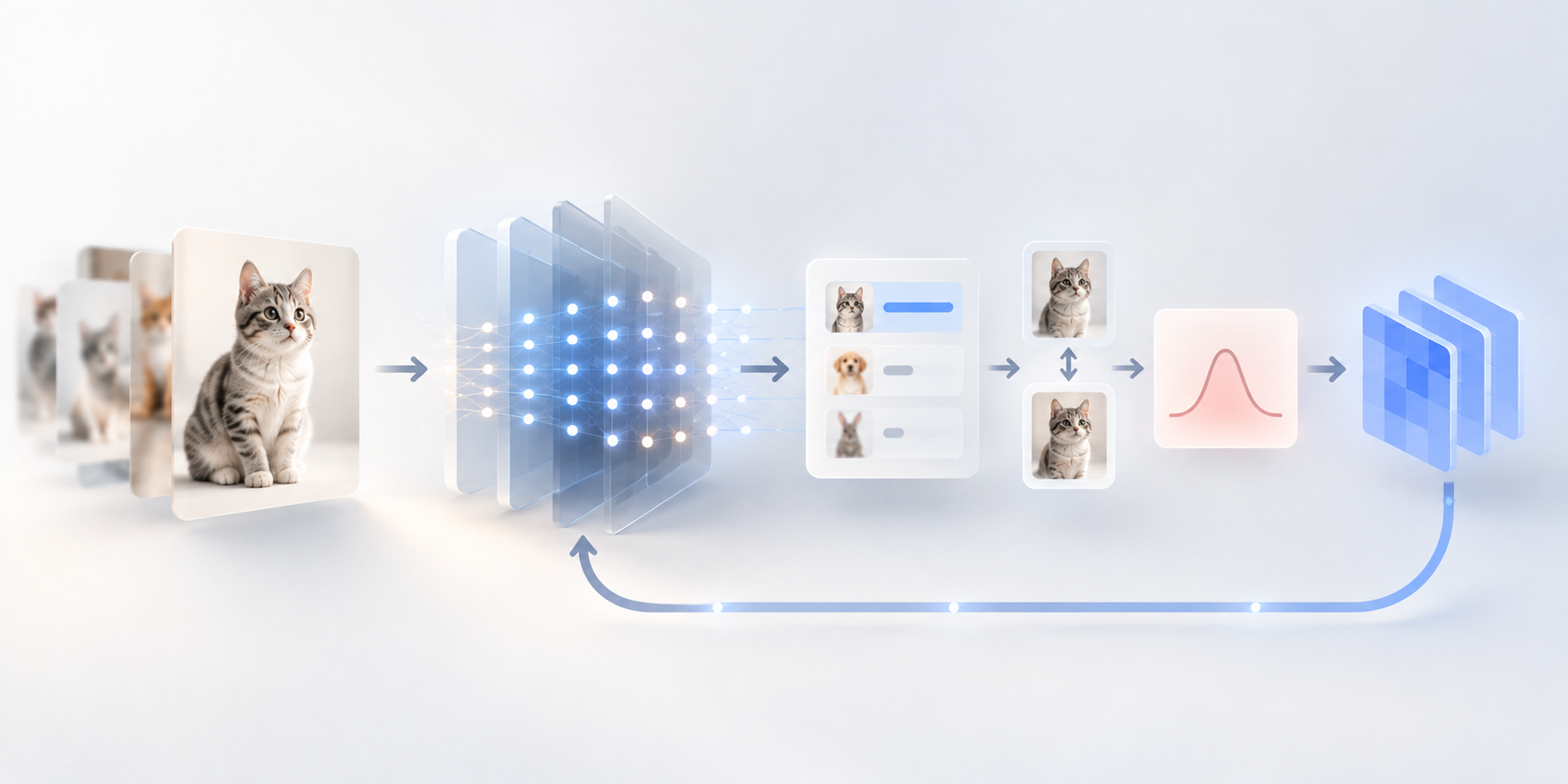
But what happens inside is different. During training, AI adjusts the parameters we discussed in an earlier post: the many numerical values that shape how a model behaves. It calculates how far a prediction is from the right answer, then nudges those numbers a little at a time in the direction that shrinks the error.
Backpropagation is the method used to calculate how the error changes with respect to each parameter. Using the result, the model adjusts its parameters and predicts again, over and over. It sounds complicated, but the core is simple. The model’s internal numbers get adjusted so the gap between prediction and answer gets smaller.
Between Concepts and Patterns
This is where the difference from people shows up.
People tend to pick up a new concept from relatively few examples, building on the experience they’ve already accumulated. Recognizing a breed of cat you’ve never seen is probably possible because you’re drawing on the concepts and experience you’ve built up so far. AI can also apply the features it has learned to new images. But it can still make mistakes when it encounters unfamiliar conditions or changes that were poorly represented in its training data. On the other hand, a pretrained model can perform well with only a small amount of new data.
Both people and AI learn from experience, but they differ in how they acquire and use what they've learned.
Learning Human Preferences
Many conversational language models undergo additional training after pretraining to better reflect human preferences. People compare several of the AI’s responses and judge which one is better. That information can be used to adjust the model so it generates answers that fit human intent and preferences more closely.
A well-known method is reinforcement learning from human feedback (RLHF). Not every way of reflecting human preferences is RLHF, though.
An AI that has been through this process may give answers that match people’s expectations better. In conversation, it can even look as if it truly understands something.
Training objectives and methods may differ, but they often share a common mechanism: adjusting the model's parameters to change its behavior. It’s a process of refining the model so it gets better at producing the answers people prefer.
So, Did It Learn?
AI clearly changes through training. Countless parameters are adjusted, and it becomes able to tell apart things it couldn’t before, or to answer new questions more appropriately. Whether we can call that the same thing as a person learning something, I’m still not sure myself. It feels a little strange that we call both of them “learning.”