Contents
Does AI Really Understand What We Say?
If you have been using AI lately, you may have caught yourself wondering:
"Isn't this basically understanding?"
When you watch it pick up on the context of a question and take earlier parts of the conversation into account, it can seem to think like a person. It can even give convincing answers to fairly complicated questions.
But that raises a question. Can we really call what AI shows here "understanding"?
When we say a person understands something, we usually mean they grasp what a concept means, change their judgment depending on the situation, and apply what they have learned to a new problem. We might also include the ability to recognize what they know and what they don't.
Is giving a correct answer the same thing as understanding what it means?
How AI Produces an Answer
The large language models (LLMs) in wide use today process information differently from people.
They break the input text into units called tokens and represent them numerically. The model then processes the context using parameters adjusted during training. It generates a response by predicting the next token, one step at a time.
In doing so, the model draws on the patterns and relationships in language that it learned. But the fact that it works this way does not, on its own, let us conclude whether AI understands meaning or not.
A thought experiment that often comes up here is the philosopher John Searle's "Chinese Room".
Imagine someone sitting in a room who does not understand Chinese. Using only a rulebook, they respond to questions written in Chinese. From outside, they look like someone who understands Chinese, but the person in the room does not know the meaning of the sentences they are handling.
Searle used this to argue that processing symbols according to rules is different from understanding their meaning.
Of course, this thought experiment does not prove whether today's AI understands. But it does raise a question: are observable abilities necessarily the same as understanding?
The Difference Between a Plausible Answer and Understanding
AI's answers sound natural because, through training on vast amounts of text, models learn knowledge, relationships, and patterns of reasoning reflected in language. As a result, they can produce responses that sound as though they came from someone who understood the question. Sometimes it solves complex problems quickly.
But a plausible answer is not always an accurate one.
It may give different answers to the same question or confidently present false information. The latter is often called a hallucination. It sometimes reaches conclusions that do not hold up logically.
There are several reasons for these errors. A model's ability to generate a natural-sounding answer and its ability to verify whether that answer is true are different abilities.
Some AI systems also use methods that can improve accuracy, such as working through problems step by step or comparing results from multiple reasoning paths. Chain-of-Thought and Self-Consistency are two examples.
That does not mean these processes work the way a person is aware of their own thinking and checks it. Whether AI expericences meaning subjectively, and how its process of reviewing its own answers relates to human self-awareness, are still unresolved questions.
Is Learning Patterns Enough?
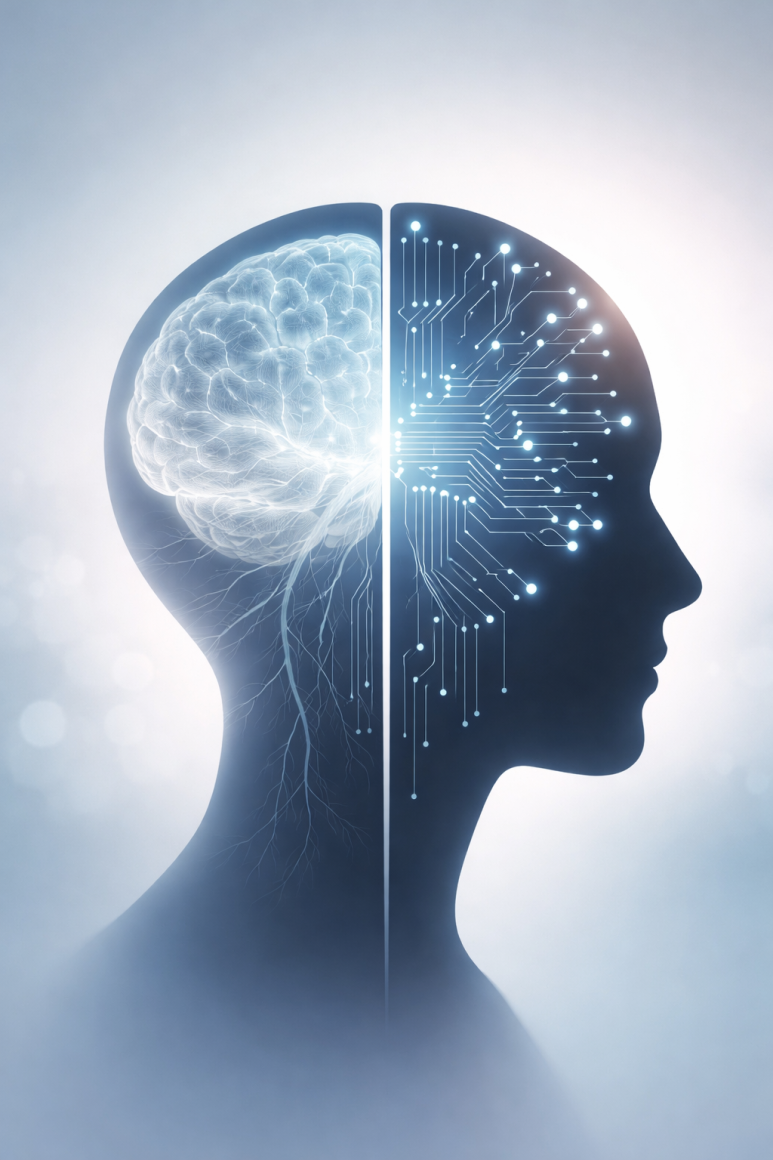
So is AI simply a system that follows patterns?
Not necessarily
As language models train on vast amounts of data, they represent complex relationships and produce useful results on many problems. As models increase in size, abilities that were not previously observed sometimes emerge. These are often described as emergent abilities.
Still, researchers debate whether these abilities really appear suddenly, or only look that way because of how they are evaluated.
Another question follows from this.
If a system can learn patterns with enough sophistication and apply them to new problems, should we treat that as something entirely different from understanding?
Some researchers argue that, from a functional point of view, AI's abilities can be seen as a form of understanding. Others hold that outward behavior alon cannot tell us whether there is any understanding of meaning.
Ultimately, whether and to what extent AI's abilities qualify as "understanding" remains an open question.
Perhaps there is no need to rush to a conclusion about whether AI understands the way people do. What matters is understanding what today's AI does well, where it can go wrong, and how much we can rely on it.
Understanding AI starts not with treating it like a person, but with knowing what it can do and where its limits lie.