Contents
Are AI Parameters Basically Brain Cells?
You have probably run into this kind of phrase a lot lately: "This model has 7 billion parameters," "GPT has hundreds of billions of parameters," and so on. And at some point, a question crossed my mind: "Wait, are parameters basically the AI equivalent of brain cells?"
Short answer: it is a pretty good analogy, but not quite the same thing. Today I want to unpack that question in the simplest way possible.
Parameters, in the simplest terms possible
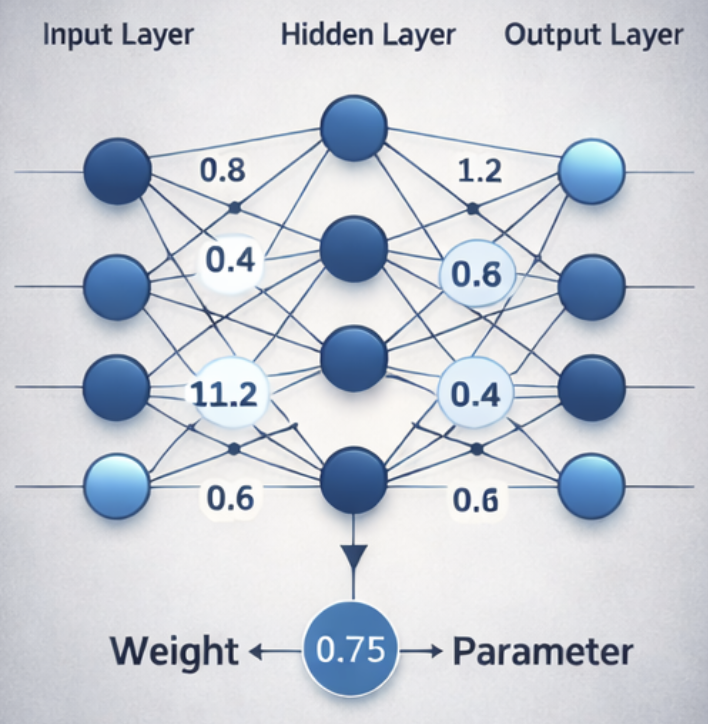
A parameter in an AI model is a number that gets adjusted during training. These numbers don't simply store the training data itself. Instead, they influence how the model represents patterns such as:
- Which words are related to which other words
- Which patterns matter
- How the model responds to a given input
So, in very simple terms: parameters are numbers that reflect patterns the model has learned.
Why it feels similar to brain cells
Think about people for a second. As we learn and gain experience, the connections in our brains — and the strength of those connections — change. New connections can form, while existing ones can become stronger or weaker. AI doesn't work the same way, of course. But there is a rough similarity in the fact that learning also changes a large number of values inside the model.
- With fewer parameters, a model has less capacity to represent complex patterns
- With more parameters, a model can have more capacity to represent complex relationships and context
Which is why I found myself thinking: "Parameters are basically the AI's brain cells."
That is half right. But it is not exactly the same thing.
But they're not the same thing
❌ Where parameters differ from brain cells:
- The connections in the brain, and their strength, continue to change with experience → In a typical AI model, parameters generally stay fixed during inference
- The brain continues to learn from new experiences → A typical AI model doesn't change its parameters every time it receives a new input
- Brain cells are part of a physical biological system → Parameters are numbers adjusted through training within the model's architecture
So, as an analogy, parameters aren't really "the brain cells themselves." They're a little closer to the traces of memory and habit formed through the connections between brain cells. Of course, this is still just an analogy to make the idea easier to understand.
So are more parameters always better?
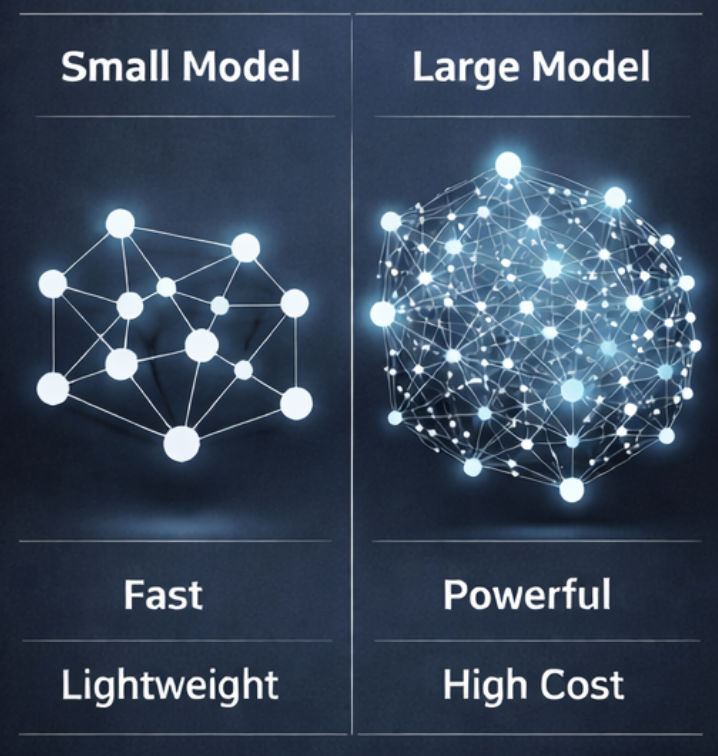
I kept coming back to this question the whole time I was digging into it. Short answer: no.
As parameter counts grow, models generally require:
- more storage and memory
- more computational resources
- higher costs to run
That's why:
- smaller models are often better suited to resource-constrained devices like smartphones
- very large models can be difficult to run on a typical local PC
- techniques such as model compression and quantization have therefore become important for making models smaller and more efficient to run
What matters is not "how many parameters," but "the right size for the problem."
To sum up
- Parameters are numbers adjusted during training that reflect patterns the model has learned
- Comparing parameters to brain cells can be useful, but the analogy has clear limits
- More isn't automatically better — the right size and structure for the purpose is what actually matters
So when it comes to parameters in AI, the real question isn't just "how many?" It's also "what kind of model is this, and what problem was it built to solve?"